D
Part of Dr.HomeFinance.com – Physician mortgage education & lender verification
VOL. 014. 2026 • LENDER NETWORK · LIVE
The doctor loan, without the small print.
A physician mortgage loan lets new and practicing doctors buy a home with little or no money down, no PMI, and an offer letter in place of pay stubs. We’ll explain what it is, who qualifies, and how to tell a real program from a repackage.
0-10%
Down payment
$0
PMI required
50+
States covered
SPECIMEN DISCLOSURE
Physician Loan Program
0 to 100% financing common
0-10 %
0 to 100% financing common
0-10 %
0 to 100% financing common
0-10 %
0 to 100% financing common
0-10 %
0 to 100% financing common
0-10 %
Dr.HomeFinance Network
VERIFIED BORROWER . 2026
$40k+ avg lifetime PMI saved
0% down available, up to $IM
Offer letter accepted 90 days early
IBR/ PAYE student-loan payments accepted
IN THIS REFERENCE . 7
CHAPTERS
A start-to-finish read on the physician mortgage — what it is, who qualifies, the honest math, and how to use it without getting hurt. About a fourteen-minute read.
Definition
How it works
Eligibility
Pros & cons
Compare
Afford
Guardrails
01
DEFINITION
What is a physician mortgage loan?
The plain-English version. A loan product a handful of banks created for doctors — designed around an offer letter and a student-loan-heavy balance sheet, not around the standard W-2 underwriting box.
A physician mortgage loan is a portfolio mortgage built by a small number of banks specifically for physicians and a handful of other high-credential professionals.
The bank keeps the loan on its own balance sheet, which means it can rewrite the rules everyone else has to follow. In a conventional mortgage, the lender plans to sell the note to Fannie Mae, Freddie Mac, or a similar agency.
To do that, the file has to match the agency’s box — two years of W-2s, a debt-to-income ratio under 43%, and a down payment large enough to avoid private mortgage insurance.
Most new doctors don’t fit that box. They have a six-figure offer letter that hasn’t started paying yet, six figures of student debt on income-driven 90 days early.
VERIFIED repayment, and no down-payment savings. A real doctor mortgage program takes those facts as a given and underwrites around them.
There are four mechanical things a real program will do that a conventional loan won’t. They’re listed on the right — and hey show up, in writing, on the closing disclosure.
What a real program does
i Closes on an offer letter
Up to 90 days before your first day of work — with no pay stubs required.
.
ii Uses your IBR/PAYE payment
Or 0.5-1% of balance — not the fully amortized number.
.
iii 0-10% down, no PMI
Up to high loan amounts covering most metro markets.
.
iv Underwrites for physicians
Income trajectory is recognized as unusually predictable.
02
HOW IT WORKS
The three things a real program actually does.
Each one is acolumn on your closing disclosure. If your lender can’t produce it in writing, the program isn’t a real physician loan — it’s a conventional loan wearing the label.
A real physician program funds 90—100% of the purchase price up to high loan amounts. You bring earnest money and closing costs — not a year of saved-up cash you don’t have yet.
ON THE DISCLOSURE . DOWN PAYMENT 0-10%
Less than 2 down on a conventional loan typically adds $150-$400/mo in PMI. A real doctor loan eliminates it entirely — saving most borrowers $40k+ over the life of the loan.
ON THE DISCLOSURE . PMI = $0
A real program funds up to 90 days before your first day — using the signed contract from your hospital, group, or fellowship as proof of income. No stubs, no W-2s.
ON THE DISCLOSURE . EMPLOYMENT OFFER
03
ELIGIBILITY
Who qualifies for a doctor loan?
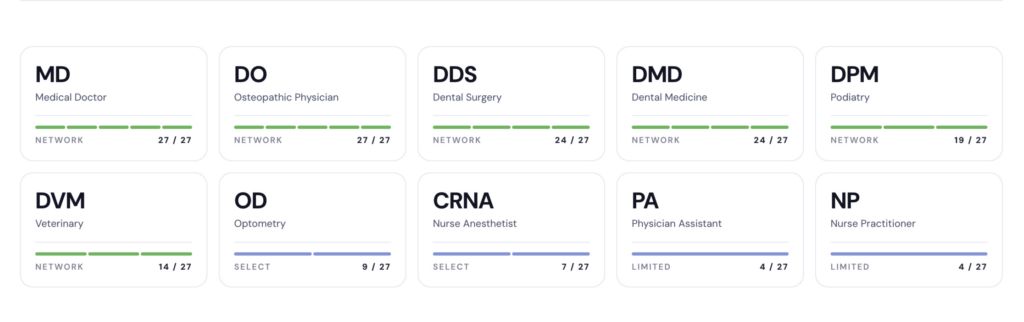
Eligibility is by credential, not by guess. Lenders publish the exact degrees and career stages they accept. Below: the credentials in our network, with answers to the questions readers actually ask.
FROM THE INBOX
Common questions, frankly answered.
A.
Yes. Most real programs will write a loan to a resident, fellow, or attending. Residents and fellows are typically capped at lower loan amounts (often $750k-$1m) because the income is lower; attendings get the full envelope.
Q.
A.
A real program will use your actual income-driven payment (IBR/PAYE/REPAYE), or 0.5-1% of the balance — not the fully amortized number a conventional lender uses. That single rule is the difference between qualifying and not qualifying for most new physicians.
Q.
A.
Most programs want a 700+ middle score, with best pricing at 740+. A 680 will still typically qualify at a small rate adjustment. Below 660, fix the score first — it’s the highest-leverage three months of your financial life.
Q.
A.
Yes — no lifetime cap. Most physicians use a doctor loan twice: once for a residency-city starter, then again for an attending home. Some programs even allow it on a refinance or second home, though rates are higher.
Q.
04
HONEST TAKE
Is the doctor loan actually a good idea?
Yes — if you treat it like a tool, not a trophy. The product is good. The most common way to get hurt with it is to use the bigger qualifying amount to buy a bigger house. Read both columns.
For .05
In the right hands – why it works
No 12-month savings sprint to get to 20% down before you close on the house you've already moved to.
Skipping mortgage insurance saves the average borrower $40,000+ over the life of the loan — a real, in-pocket number.
The income-driven payment, not the fully amortized one, drives your debtto-income ratio.
You can close before day one — up to 90 days early — meaning you move once, not twice.
A real program typically prices within 0.125-0.375% of a conventional 20%- down loan. PMI savings usually erase the gap.
AGAINST – 05
Where it goes wrong – how to avoid it
A bigger qualifying number is not a bigger budget. The same trap as any first-time buyer, just at a higher dollar amount.
If you have to sell in two years, you'll likely write a check at closing. Don’t use it for a house you'll outgrow in 24 months.
Expect 0.125—0.375% more than a 20%-down conventional. Worth it if you'd otherwise pay PMI; not if you have the cash.
Real ones don’t. Always compare line-by-line on the Loan Estimate, not just the headline rate.
Don't take a 5/1 ARM unless you have a specific, dated plan to refinance or move before the reset.
05
COMPARE
Doctor loan vs. conventional, line by line.
Six rows decide whether the physician program is the right move for you. Run your situation against the table. If three or more rows favour the physician column, the math is on your side.
OPTION A. RECOMENDED
Physician loan
DOWN
100% financing common up to high loan amounts
PMI
No private mortgage insurance, ever
INCOME
Close up to 90 days before first day of work
SL DTI
Or 0.5-1% of balance — not fully amortized
RATE
+0.125 to +0.375% vs. conventional
KNOWS MDS
Offer letters, RVUs, locums, 1099 — all familiar
vs.
OPTION B - STANDARD
Conventional w/ 20% down
DOWN
..to avoid PMI on a standard conforming loan
PMI
Until 22% equity, if less than 20% down
INCOME
Often a full month after you start work
SL DTI
Often the difference between approve and decline
RATE
..jf you actually have 20% to put down
KNOWS MDS
File kicked out on anything non-standard
06
AFFORD
How much can I actually afford’?
The honest answer is smaller than the qualifying answer. Most physicians do well at 2x gross income on the first home and no more than 28% of gross income on principal, interest, taxes, and insurance combined.
Slide your real numbers in.
A back-of-the-envelope estimator using the “28% of gross” rule with realistic taxes, insurance, and a 6.75% rate for a 30-year doctor loan. Planning tool, not a pre-approval.
07
GAURDRAILS
Should ould you really lly doo this?
Use the doctor loan if you can answer “yes” to all four. If a question lands as a “no” or a “maybe,” rent another year. The product will still be here when you’re ready.
01
Will you stay in this market for at least five years?
A doctor loan starts with little or no equity. If you sell in year two, you’ll likely write a check at closing — a five-year horizon turns that math from a coin flip into a near-certainty.
5+ yr horizone
Rent another year
02
Is the payment under 28% of gross income?
That’s the line where physicians comfortably absorb the cost of a house and still save 15-20% of income. Above 35%, the budget gets tight fast — especially if you’re still paying down loans.
PITI < 28% gross
PITI > 35% gross
03
Do you have an emergency fund?
Three to six months of expenses outside of the down payment, in cash. A doctor loan is a great product. It is not a substitute for liquidity when the water heater dies in month three.
3-6 months, cash
Build first
04
Have you compared two real lenders, side by side?
Pricing varies more across “physician” programs than across conventional ones. A real program comes from a bank that holds the note; a repackage comes from a broker shopping a wholesale wholesaler. Get two Loan Estimates.
2 Load Estimates
Get a second
TAKE THE NEXT STEP
Done reading? Pick Your move
MD Mortgage Loan is the education side of the Dr. HomeFinance ecosystem. Whether you need a lender, a realtor, or an investor — one of these doors is the right one.
01.
Find physician-focused banks
Match with a bank-direct lender from our verified Dr. HomeFinance network — the real programs only, no broker repackages.
drhomefinance
02.
Match with a physician-focused realtor
Realtors who have actually closed for doctors before — familiar with move-once timelines, fellowship contracts, and dual-physician offers.
drhomematch
03.
Looking to invest?
Match with a bank-direct lender from our verified Dr. HomeFinance network — the real programs only, no broker repackages.
drhomeinvestor
MD Mortgage Loan
A plain-english education resource for physicians, dentists, and other high-credential professionals shopping for a real doctor mortgage.